The Short Answer
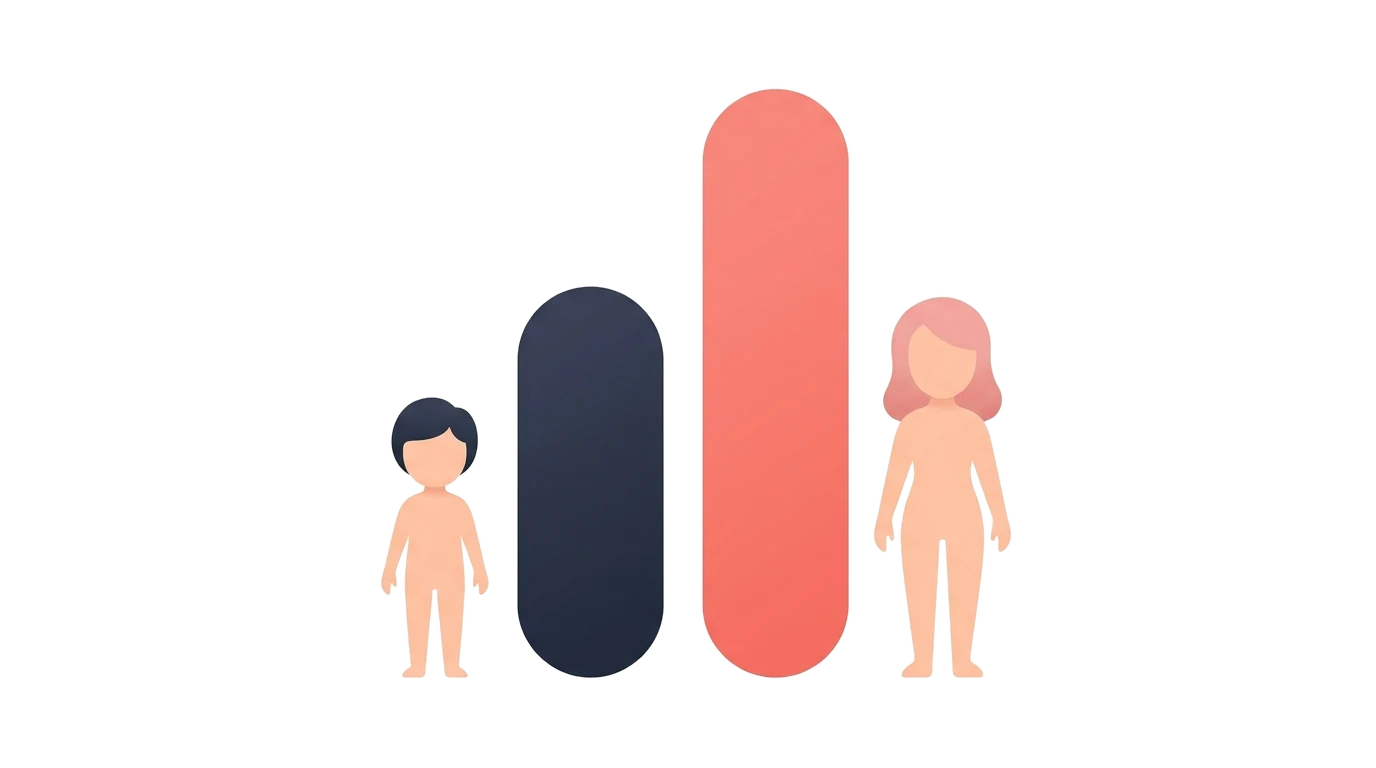
The orgasm gap is the consistent finding that heterosexual men orgasm during partnered sex far more often than heterosexual women, roughly 95% against 65% in large national samples. It is not primarily biological: lesbian women report rates around 86%, close to men. The main cause is that heterosexual sex is commonly defined around penetration, which rarely provides the direct clitoral stimulation most women need to orgasm.
Key Takeaways
Roughly 95% of heterosexual men orgasm during partnered sex, against 65% of heterosexual women.
Lesbian women report about 86%, which rules out biology as the main explanation.
Most women need direct clitoral stimulation, and penetration alone rarely provides it.
The gap narrows sharply when sex includes more than intercourse.
What the Research Found
A large US national sample produced the figures most often quoted: heterosexual men were the group most likely to say they usually or always orgasm during partnered sex, at around 95%. Heterosexual women reported roughly 65%. A 2024 review in The Journal of Sexual Medicine found a similar shape across age groups, with men between 70% and 85% and women between 46% and 58%.
The finding that makes the whole picture click is what happens when you compare across sexual orientation. In the same national sample, lesbian women reported orgasm rates of about 86%, and bisexual women about 66%. If the gap were driven by female anatomy or by some inherent difficulty, lesbian women would show the same low rate as heterosexual women. They do not.
The conclusion researchers draw
The gap is not a difference between men and women. It is a difference between the kinds of sex people are having. Where the encounter reliably includes direct clitoral stimulation, the gap largely disappears.
Why the Gap Exists
Several things stack on top of each other, and none of them is anyone's fault individually. Together they produce a very consistent outcome.
Sex is defined as penetration
The cultural script treats intercourse as the main event and everything else as preliminary. That script reliably produces orgasm for the penetrating partner and unreliably for the other. Only a minority of women orgasm from penetration alone.
The clitoris is misunderstood
It is a substantially internal organ with far more nerve endings than the external part suggests. Its most sensitive area is outside the vaginal canal, which is precisely why penetration alone often does not reach what needs reaching.
Sex ends at his orgasm
Male ejaculation is treated as the natural end point of the encounter. When one person's orgasm defines the finish line, the other person's is structurally optional.
Arousal timelines differ
Women commonly need considerably longer to reach full arousal. In encounters built around a shorter timeline, the slower process simply never completes.
Faking closes the feedback loop
Faking orgasm is common, understandable and self-defeating. It ends the encounter, reassures the partner, and removes the information that would have changed anything.
Nobody asks
Many people have never been asked what actually works for them, and many have never been given the language to answer. Silence preserves the default script.
What Actually Closes the Gap
The interventions that work are unglamorous and specific. They are also well supported by the same body of research that identified the problem.
Include direct clitoral stimulation as standard. Not as a warm-up, as part of sex itself, including during penetration. This single change accounts for most of the difference in the data.
Stop treating one orgasm as the end. If the encounter ends the moment one partner finishes, the structure guarantees the outcome. Deciding together when it ends changes everything.
Extend the build-up substantially. Full arousal takes time, and the physical changes it produces are what make orgasm possible. Rushing it is not a shortcut, it is a cancellation.
Choose positions that allow access. Some arrangements make simultaneous clitoral contact easy and others make it impossible. Our sex positions guide covers which is which by goal.
Use lubricant. Friction and discomfort make orgasm considerably less likely, and the right lubricant removes that obstacle for a few pounds.
Stop faking, gently. You do not need to confess to a history of it. Simply start giving real feedback going forward: "a bit lighter", "keep doing exactly that", "slower".
Learn your own response first. It is very hard to direct someone towards something you have not mapped yourself. Solo exploration is the most reliable route to specific instructions.
If You Are the Partner With the Easier Time
This section is written for men in heterosexual relationships, because that is where the data is clearest, and the point is not blame. Almost nobody was taught any of this. But once you know the gap exists, closing it is largely within your control.
Ask, and make it safe to answer
"Show me what you like" and "tell me if you want it lighter or firmer" are more useful than any technique you could read about, because the answer differs for every person and changes across the month.
Then respond well to the answer. If a suggestion is met with defensiveness or wounded pride, you will not get another one.
Take the pressure off the outcome
Treating her orgasm as a test of your competence adds pressure that makes orgasm less likely, not more. Anxiety and arousal compete for the same attention.
"I want you to enjoy this, and it is fine if you do not finish" removes the performance framing for both of you, which paradoxically improves the odds.
Our For Him guide covers this ground in more depth, including what partners actually report as mattering most. How to talk about sex gives you a structure for asking, and what happens afterwards matters more to the overall experience than most people realise.
When Difficulty Orgasming Is Medical
Most of the gap is structural rather than clinical. But persistent difficulty reaching orgasm, particularly when it represents a change from before, has causes worth investigating.
Medication. SSRIs and some other antidepressants very commonly delay or block orgasm. This is well known to prescribers and there are often alternatives, so it is worth raising rather than stopping medication yourself.
Hormonal change. Contraception, breastfeeding, perimenopause and menopause all affect arousal and sensation.
Pelvic floor function. Both weakness and excessive tension can interfere. Pelvic floor training has good evidence behind it for arousal, lubrication and orgasm.
Pain. If sex hurts, orgasm is unlikely. Deal with the pain first, and see why sex hurts for the common causes.
Anxiety, stress and past trauma. All are legitimate medical territory, and a psychosexual therapist works with them routinely.
A note on what is normal
Not orgasming every time is entirely normal and is not evidence of a problem, in anyone. Never orgasming, or a clear change from what used to happen, is worth a conversation with a GP or a psychosexual therapist. Anorgasmia is a recognised and treatable condition.
Further Reading
This article supports our full For Her guide, which covers the subject end to end. For anything about how we write and review this material, see about us or the FAQ.
For clinical and public-health information beyond the scope of an educational guide, these independent sources are worth reading:
A note on medical advice
How To Sex is an educational publisher, not a medical provider. Nothing here is a diagnosis or a treatment plan. Anything involving your own body, symptoms, medication or pregnancy should go to a qualified healthcare professional.
Frequently Asked Questions
What is the orgasm gap?
It is the consistent research finding that heterosexual men orgasm during partnered sex far more often than heterosexual women. A large US national sample found about 95% of heterosexual men usually or always orgasm, compared with about 65% of heterosexual women. Reviews across age groups find a similar pattern.
Why do women orgasm less than men during sex?
Not because of anatomy. Lesbian women report orgasm rates of around 86%, close to men, which rules out biology as the main explanation. The gap is driven by heterosexual sex being defined around penetration, which rarely provides the direct clitoral stimulation most women need, combined with encounters typically ending at the man's orgasm.
Is it normal not to orgasm from penetration alone?
Yes, and it is the majority experience. Only a minority of women orgasm reliably from penetration without additional clitoral stimulation. This is a matter of anatomy rather than of anything being wrong, which is why including direct stimulation as a standard part of sex closes most of the gap.
How can couples close the orgasm gap?
Include direct clitoral stimulation as part of sex rather than as a warm-up, extend the build-up considerably, stop treating one partner's orgasm as the end of the encounter, choose positions that allow clitoral access during penetration, use lubricant, and give real-time feedback instead of faking.
Why do people fake orgasms?
Usually to protect a partner's feelings, to end an encounter that is not going anywhere, or to avoid a difficult conversation. It is understandable and very common, and it is also self-defeating, because it confirms that whatever is happening is working and removes the information that would have changed it.
When should I see a doctor about difficulty orgasming?
If you have never been able to orgasm, or if you previously could and now cannot, it is worth seeing a GP. Common and addressable causes include SSRI antidepressants, hormonal contraception, menopause, pelvic floor dysfunction and pain during sex. Persistent difficulty is a recognised condition called anorgasmia and it is treatable.